
Still Loathing
Or how I will always hate the movie Love, Actually

In honor of the holidays, I am resharing this piece. Because in this constantly chaotic, dumpster-fire world, you know what I want you to STILL care about? How much I loathe THIS film:
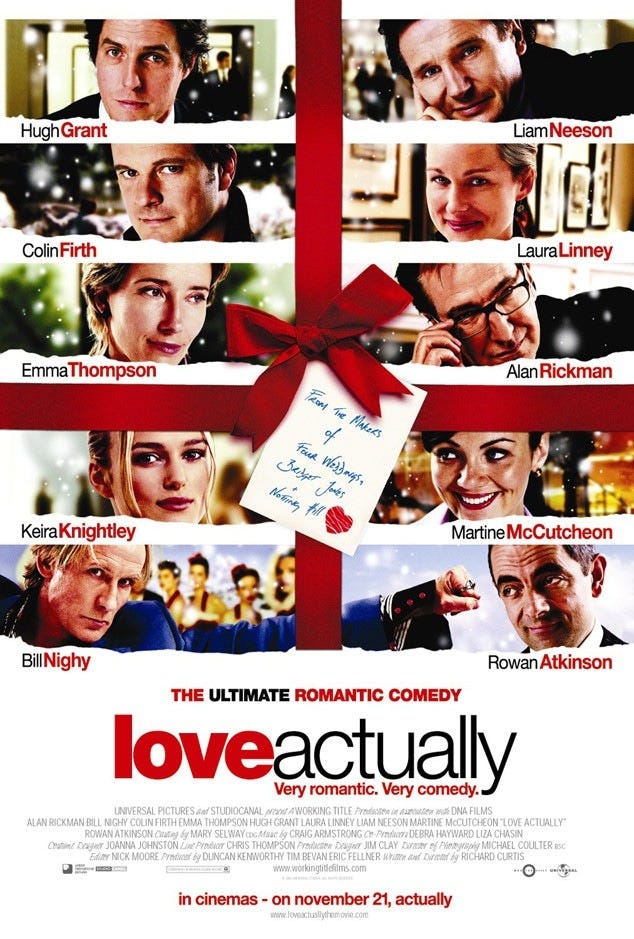
This is the hill I will die on. I’ve said it once, I’ll say it again—I’ll have it engraved on my TOMBSTONE—Love, Actually is, unequivocally, the worst.
“Okay, is it actually the worst?” I can hear you asking yourself. “Surely, there are worse films you could focus your rage upon, Kim.” And perhaps. PERHAPS. Because lord knows there are problematic films a-plenty.
But in a world where this tinsel-covered pile of misogyny has somehow weaseled its way into the hearts and minds of millions of people who find it “sweet” and “romantic” and “flawed but also SO watchable” — in a world where it has somehow wound up in the holiday canon even though the only place it belongs is an actual cannon— SOMEONE needs to be speaking out about it and declaring (in, perhaps, just the slightest unhinged way) how much they loathe this film.
And my friends, that someone is me.
This film has been around over twenty years. Twenty years! How? Why are we will watching it? And why aren’t more people speaking out and raging against it like me and my late friend Gabriel Peters-Lazaro, who understood how deplorable this film truly is and was perhaps the only other human I’ve met who has matched my passion for railing against it, once describing it as “the devilry of late-stage capitalism.”
Those of you who have heard about this every year, you might have thought that I’d get over it by now. You might have thought that by 2025 I’d have run out of things to say and/or tire of my angry feminist rant. But bwahahaha you were wrong!
But is a film really worth getting this heated over, you might be thinking. It’s just entertainment, it’s for funsies.
Yes, actually. It is entirely worth getting this heated over. Because films both reflect and shape us. And while they are often just for funsies, that doesn’t mean they don’t have an impact.
So without adieu, I present to you my top 10 reasons for loathing Love, Actually:
It’s fat-phobic
Women are repeatedly and routinely called chubby and/or fat in a blatantly disdainful manner. And it’s incredibly problematic to only be centering and valuing thin bodies, as if they are somehow worthier and more beautiful than larger bodies and what we should all esteem to. It fuels diet culture, makes women feel shame over their perfectly healthy, glorious bodies, and funnels energy away from living and thriving and creating and fighting for a better world, wasting it instead on trying to conform and control and tame our bodies. (And, btw, not that it matters, but the women in question aren’t actually chubby or fat).
The fat-phobic humor feels just about as old and tired as the misogyny in this film, but truthfully the two go hand in hand.
The diversity in this film is almost non-existent
Despite the fact that this film takes place in London, an incredibly diverse city, the only diversity in this film is a) Keira Knightly’s husband (played by Chiwetel Ejiofor, who has almost no screen time and hardly any lines), b) the Portuguese housecleaner (and, very briefly, her family) whom Colin Firth obsesses over, and c) two women of color whom Emma Thompson briefly talks to in the background of a scene at precisely 1:54:50 into the movie. That’s it!
In a post #metoo world we’re still somehow romanticizing plots involving men lusting after their employees
Oh, I know what you’re going to say. It’s not like these men are harassing them! (Are we sure about that?) They’re just attracted to them! And, in most cases, these are mutual attractions! It’s sweet that the Prime Minister (Hugh Grant) likes his assistant, Natalie (who, btw, gets sexually assaulted by the President of the United States and then somehow blames herself). And it’s harmless that Colin Firth likes his housecleaner (even though they don’t share a language and he literally knows nothing about her).
But these are men who employ these women and hold far more power, which is hugely problematic. We’ve seen this play out in real life. We know how it goes. So can please stop glorifying these types of scenarios and acting like they’re entirely harmless?
The storyline that seems to capture people’s hearts the most involves an obsessed stalker
Isn’t it so incredibly heart wrenching that Keira Knightly’s husband’s best friend (Andrew Lincoln) is truly in love with her, even though he’s literally never spoken a word to her in her entire life? (A running theme btw). And how incredibly cute that Keira Knightly’s husband’s best friend fucks up filming her wedding day by obsessively filming only her in close up. Also don’t you love how sweet it is that he shows up on her doorstep like a creeper on Christmas Eve to silently confess his love in written form even though her husband—his best friend—is in the other room, and, I can’t overstate this enough, this dude has barely ever spoken to her?
Quick, what’s an 8-letter word for a man’s actions when he’s decided he loves a woman and is going to keep pursuing her even though she a) has already told him no, and/or b) she doesn’t even know him? Were you going to say R o m a n t i c? Because that’s not it. Try S t a l k i n g.
(Btw, just a few years ago Richard Curtis, the film’s director, admitted that this storyline was a huge mistake. Finally!)
The film wastes an entire movie minute (which is, like, 60 IRL minutes) on said stalker wandering around feeling sorry for himself
After Keira Knightley shows up at her stalker/husband’s best friend’s house to see the creepy wedding video he filmed, the movie proceeds to play a sad Dido song as said stalker wanders into an alley alone afterwards, paces back and forth, grabs his head in angst, and then wanders off…and paces and grabs his head some more…and then wanders into a building where he’s all angsty…and then wanders past the river all mopey and angsty. For a full movie minute, people! We’re supposed to feel SORRY for the stalker!?
They cast Goddess Dame Emma Thompson and made her a sad sack wife
I’m sorry, but this might be the most unforgivable crime of all. I’ve said it before and I’ll say it again, no one puts Emma Thompson in a sad sack corner! She might be a lot of things - a Seer, a Goddess, a Shakespearean Queen - but she is NOT some washed up wife who just sits around feeling sorry for herself when she realizes her husband is buying jewelry for the assistant he’s lusting after (yet another problematic employer/employee storyline!). Are you kidding me with that shit? Do you think that I think for a second that Emma Thompson would stand for that and not kick that man to the curb? Get out of here.
Laura Linney isn’t allowed to have a relationship because she has a brother with special needs
In the middle of making out with the colleague whom she apparently “loves” but has never really spoken to (do we see a trend?), Laura Linney’s phone rings and she answers to talk to her brother who’s “not well” and “calls a lot” which temporarily kills the vibe. But then the phone rings again right as she and her colleague start making out, and so she answers it and talks at length and promises to come right over to help her brother. (Which, as an aside, might be a bit of a boundaries issue, based on how this whole situation plays out in the film. But details details.) And basically…that’s it! No more making out or romantic relationships for Laura Linney! Because, as we all know, when you have family obligations and/or someone to care for you can’t possibly have a life of your own.
The meet cute in this film is two porn stand-ins faking blow jobs and sex
Listen, I’m not trying to be a prude here. Sex isn’t wrong or bad. And many people enjoy porn. (Is it a problematic industry? Does it fuel misogyny and violence toward women? Yes and yes. But, to be fair, that’s not what is presented here.) But there is something about this scenario that reads so very male fantasy and feels like toxic masculinity in the form of the ever-persistent male gaze. It also feels entirely gratuitous to the movie and like it’s just an excuse to put more female nudity into the film and have a man grab a woman’s breasts on screen.
There are numerous gratuitous scenes of half-naked women
Speaking of gratuitous nudity, there’s not one but TWO scenes of Alan Rickman’s assistant lounging around in lingerie for literally no apparent reason. In one scene she strips down to her lacy red lingerie alone in her bedroom, and then…just literally walks off screen. In another scene she’s lounging around like a Victoria’s Secret model in her apartment, wearing nearly nothing as she puts on the necklace he gave her.
And then we have Colin Firth’s housecleaner in what is perhaps my favorite scene of the movie (and by favorite I mean the one that makes me want to stab out my eyes). Colin Firth is typing away outdoors beside a lake with his manuscript stacked next to him (brilliant idea, what could go wrong), and as his housecleaner brings him a cup of tea the wind picks up and blows the manuscript toward the water. And so, of course, the housecleaner goes after it and proceeds to strip off all her clothes so she can jump in after the pages. And of course it’s all filmed in the most male-gaze-focused way possible, tilting up from her bare feet to her removing her shirt, emotive music playing, and then becoming sloooooow motion as it tilts down from her bra to her undies and the tattoo on the small of her back. In fact, it was at this moment in the theater that I turned to my friend and said, “If this isn’t a dream sequence I’m going to kill someone.” Spoiler alert, it was not a dream sequence.
Literally no one in this film is in love, actually
The premise of this film is that love is all around us. And that’s true. It’s there in our friendships and in our familial relations, in our communities and our partnerships, and it’s there in romantic relationships, too. But guess what? That’s not what this film is about! This film is about lust and projection and obsession and fantasy. The people “in love” in this film usually don’t know the people they’re obsessing over, and, in fact, most of the time they’ve never even spoken. And yes, that’s also a pretty common human experience. Most people have crushed over someone from afar (see most of my teen years), but let’s all be clear: that is not love. So call this movie Lust, Actually, or Obsession, Actually, or I-Think-You’re-Hot-and-am-Now-Projecting-Fantasies-of-Life-Fulfillmet-Onto-You, Actually. But love? I don’t think so.
If you’ve gotten this far and enjoyed my feminist rant, I think its safe to say you will love my books!
If you haven’t yet, please consider purchasing Hear Her Howl or requesting it at your library! And if you’d be willing to leave a review on Amazon or Barnes & Noble to help others find it, I’d be forever grateful!
And if you need further proof of how problematic this terrible holiday film is, here’s some additional reading material for your holiday season - enjoy!
Love, Actually is the Least Romantic Film of All Time - Christopher Orr via The Atlantic
I Rewatched Love, Actually and am Here to Ruin it For All of You - Lindy West via Jezebel
I Re-watched Love, Actually & It’s Still the Worst - Katy Harrington via Refinery 29